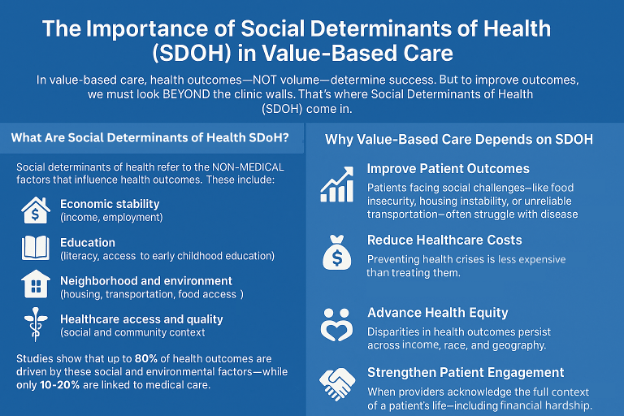
In value-based care, health outcomes—not volume—determine success. But to improve outcomes, we must look beyond the clinic walls.
That’s where Social Determinants of Health (SDOH) come in.
What Are Social Determinants of Health?
Social determinants of health refer to the non-medical factors that influence health outcomes. These include:
- Economic stability (income, employment)
- Education (literacy, access to early childhood education)
- Neighborhood and environment (housing, transportation, food access)
- Healthcare access and quality
- Social and community context (support systems, safety)
📊 Studies show that up to 80% of health outcomes are driven by these social and environmental factors—while only 10–20% are linked to medical care.
Why Value-Based Care Depends on SDOH
Value-based care (VBC) shifts the focus from fee-for-service to outcomes-driven reimbursement. Providers are rewarded for:
- Reducing hospital readmissions
- Improving chronic disease management
- Enhancing patient experience and well-being
To succeed in VBC, providers must address the social factors that drive poor health outcomes. Here’s why:
1. Improve Patient Outcomes
Patients facing social challenges—like food insecurity, housing instability, or unreliable transportation—often struggle with disease management.
✅ Identifying and addressing these root causes leads to better medication adherence, fewer complications, and improved long-term health.
2. Reduce Healthcare Costs
Preventing health crises is far less expensive than treating them. By investing in social interventions:
- Meal delivery for chronically ill patients
- Rideshare partnerships for medical appointments
- Utility assistance to stabilize home environments
...systems can reduce costly ER visits and hospital stays.
3. Advance Health Equity
Disparities in health outcomes persist across income, race, and geography.
🧑🏽🤝🧑🏾 Community health worker programs, social service referrals, and culturally competent care help bridge the gap—bringing VBC closer to its goal of equitable, high-quality care for all.
4. Strengthen Patient Engagement
When providers acknowledge the full context of a patient’s life—including financial hardship, caregiving duties, or trauma—patients feel seen and supported.
📈 That trust leads to:
- Stronger patient-provider relationships
- Better treatment adherence
- More proactive health behaviors
5. Align with Policy and Payer Requirements
Federal and state programs increasingly reward SDOH integration:
- Medicaid Managed Care Organizations (MCOs)
- Accountable Care Organizations (ACOs)
- CMS Innovation Models
These programs incentivize providers to collect, report, and act on SDOH data as part of their VBC models.
How to Integrate SDOH into Value-Based Care
To embed SDOH into your value-based strategy:
✅ 1. Screen for SDOH
Use EHR-integrated intake tools and questionnaires to capture social risk factors at the point of care.
✅ 2. Build Cross-Sector Partnerships
Collaborate with:
- Food pantries
- Housing organizations
- Transportation networks
- Behavioral health providers
✅ 3. Invest in Analytics
Leverage predictive analytics and risk stratification to:
- Identify high-risk patients
- Allocate care coordination resources
- Tailor interventions effectively
✅ 4. Train Your Teams
Educate clinicians and care managers on:
- The impact of SDOH
- Trauma-informed communication
- How to refer patients to social support services
The Future: Whole-Person Care at Scale
As the U.S. healthcare system accelerates toward value-based care, SDOH will become central to quality, cost, and equity strategies.
Forward-thinking organizations are already embedding SDOH into:
- Population health management
- Risk-based contracting
- Patient-reported outcomes measurement
Value-based care is not just about treating illness—it’s about creating systems that support health, dignity, and opportunity.
Final Thought
👉 To thrive in value-based care, providers must go beyond clinical interventions.
Addressing SDOH isn’t optional—it’s foundational to building a healthier, more equitable future.